


Blood Biomarkers Offer New Clues to Brain Health
Researchers with the Ann S. Bowers Women’s Brain Health Initiative, a flagship project of the UC Noyce Initiative, are making promising advances in the use of blood-based biomarkers to better understand neurological changes in women during midlife — a critical window that may hold important clues to brain health and dementia risk later in life.
The emerging research is helping address a significant gap in neuroscience: there is a deficit of scientific data related to what happens to the brain in real time during menopause, even as evidence increasingly points to the menopausal transition as an important period for understanding healthy brain aging.
Researchers identify a specific molecular ‘signature’ of menopause
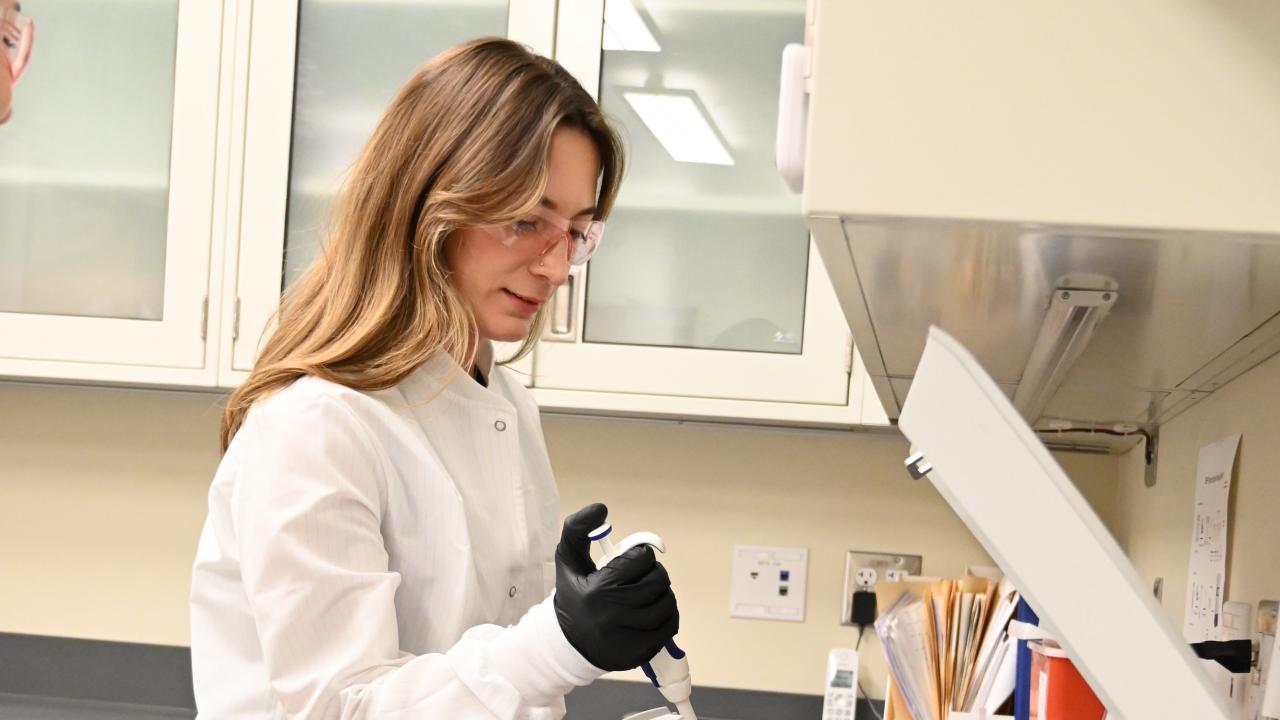
In a recent study, researchers examined proteins circulating in the blood of women before, during and after menopause. Using ultrasensitive proteomic technology, the team discovered 16 proteins that become elevated during the menopausal transition and represent biological processes related to inflammation, metabolism, brain cell communication, and Alzheimer’s disease.
Perhaps most strikingly, these molecular changes were more tightly linked with hormones than chronological age – allowing researchers to identify a specific molecular ‘signature’ of menopause that may provide an early window into an individual’s later life brain health.
Researchers then looked for the same biological signature in four independent cohorts of older women, with data drawn from more than 10,000 individuals. Women with elevated levels of the menopause protein signature were more likely to have poorer cognitive outcomes and accelerated organ and cellular aging, building mounting evidence that the molecular shifts that are detectable in mid-life have ties to longer-term brain health outcomes.
The findings do not mean menopause causes Alzheimer’s disease. Instead, they offer researchers a potentially powerful new window into biological processes occurring decades before symptoms of dementia typically appear.
Kaitlin Casaletto, a neuropsychologist at the UC San Francisco Edward and Pearl Fein Memory and Aging Center and director of the Biomarkers Hub for the Ann S. Bowers Women’s Brain Health Initiative, said the findings illustrate why midlife deserves much greater attention from brain researchers.

"We tend to think about dementia as a disease of older age, but the biology that shapes our brain health is unfolding decades earlier,” Casaletto said. “Menopause gives us an incredible window into that biology. If we can understand what is changing during this transition and what promotes risk or resilience, we may ultimately identify new opportunities to protect brain health long before cognitive symptoms emerge.”
The science has implications well beyond women’s health. Researchers hope studying menopause as a major neuroendocrine transition can reveal fundamental mechanisms of brain aging that are relevant to everyone.
For Emily Jacobs, director of the Ann S. Bowers Women’s Brain Health Initiative at UC Santa Barbara, that makes midlife an especially important frontier for dementia research.
Although symptoms such as memory impairment typically emerge much later in life, the biological changes that eventually contribute to dementia can begin decades earlier, Jacobs said. Understanding what happens during menopause could therefore help researchers identify some of the earliest biological changes associated with later risk, as well as factors that promote resilience.
“Dementia prevention starts in midlife,” Jacobs said.
Following the brain through menopause
Those findings are also helping lay the scientific groundwork for the Longitudinal Menopause Project, or LMP, an ambitious effort to map what happens to the brain and body as women move through menopause.
Rather than capturing a single snapshot, the project will follow participants across the menopausal transition. Researchers will combine advanced brain imaging and blood-based biomarkers with neuropsychological and neurological assessments, reproductive health information, genetic profiles and wearable technology that can capture factors such as physical activity and sleep.
The approach is similar in concept to research that has mapped how the adolescent brain changes during puberty. Menopause is also a whole-body endocrine transition, but scientists lack comparable longitudinal data showing how the human brain changes throughout the process.
The project will harness expertise across the University of California, with study sites at UC San Francisco, UC Santa Barbara and UC San Diego. Participant recruitment is underway at all three sites.
Researchers ultimately intend to create an open-science resource that can be used by scientists around the world, allowing discoveries from the project to extend well beyond the original research team.
Research gains national attention
The scientific promise of the work is already attracting attention beyond academia. The Longitudinal Menopause Project and the broader work of the Ann S. Bowers Women’s Brain Health Initiative were recently featured by Good Morning America and The New York Times, bringing national attention to the need for more research into menopause and brain health.
That visibility has practical importance for science. Broad public awareness can help researchers recruit participants, educate communities about women’s brain health and elevate an historically understudied area of biomedical research among policymakers and research funders.
The Longitudinal Menopause Project grew from the visionary gift from the late Ann S. Bowers and the collaborative research infrastructure established through the Ann S. Bowers Women’s Brain Health Initiative. Initial funding from the UC Noyce Initiative helped make the project possible, providing researchers with foundational support to pursue an ambitious scientific question in an area where fundamental data are still lacking.
Today, the project is leveraging innovative public-private partnerships and the collective research strength of the University of California to begin filling that gap and potentially change how scientists understand the relationship between menopause, aging and lifelong brain health.
Participate in the Longitudinal Menopause Project