


A Quantum Sensor that Learns as it Goes
The multi-campus team of experimentalists and theorists – including Professor David Weld from UC Santa Barbara, Distinguished Professor Richard Scalettar and Assistant Professor Nancy Aggarwal from UC Davis, and Professor Ehud Altman from UC Berkeley – is combining their expertise from across quantum science to explore the intersection of quantum measurement and many-body quantum dynamics.
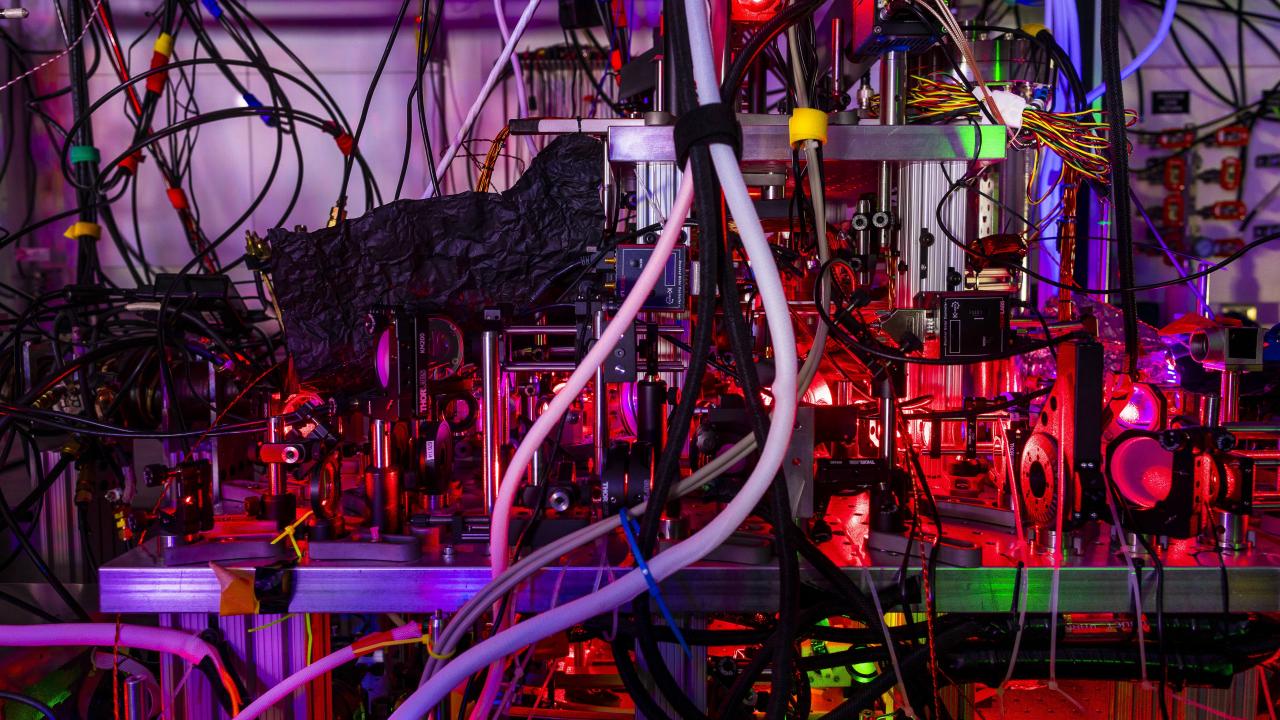
With UC Noyce Initiative funding, the researchers created a quantum sensor that does something unusual – it learns as it goes. The sensor takes a measurement, uses that information to decide what it should measure next and continually adjusts its approach. In experiments, the system accurately determined an unknown magnetic field in real time without having to repeatedly stop and reset.
Why does that matter?
Quantum systems can be extraordinarily sensitive, but harnessing and controlling them is challenging. Giving a quantum system the ability to respond to information as it is collected could ultimately make quantum technologies more adaptable and useful.
The researchers see potential applications for this approach in sensing, control, stabilization and memory, all of which are building blocks that could contribute to future generations of quantum technology.
Much like the sensor itself, the collaboration evolved through learning and feedback, with researchers having an “aha” moment at UC Davis revealing unexpected connections among the researchers’ work and new possibilities for collaboration.
“Noyce funding has uniquely encouraged and sustained new cross-campus collaborations in a rapidly developing area,” said Weld, the principal investigator of the project. UC Santa Barbara, “When (we met), we were all struck by thematic overlaps between our three very different areas of research, which would never have been uncovered without support for this kind of collaborative curiosity-driven project.”
Those connections are already expanding. New collaborations have emerged with other researchers at UC Santa Barbara and UC Berkeley. The project also has contributed numerous presentations throughout the country and two research publications, with additional papers in development.