



Perfect Imperfection
Diamonds are prized for their perfection. But for a multi-campus team of UC Noyce Initiative researchers, their real potential lies in their defects.
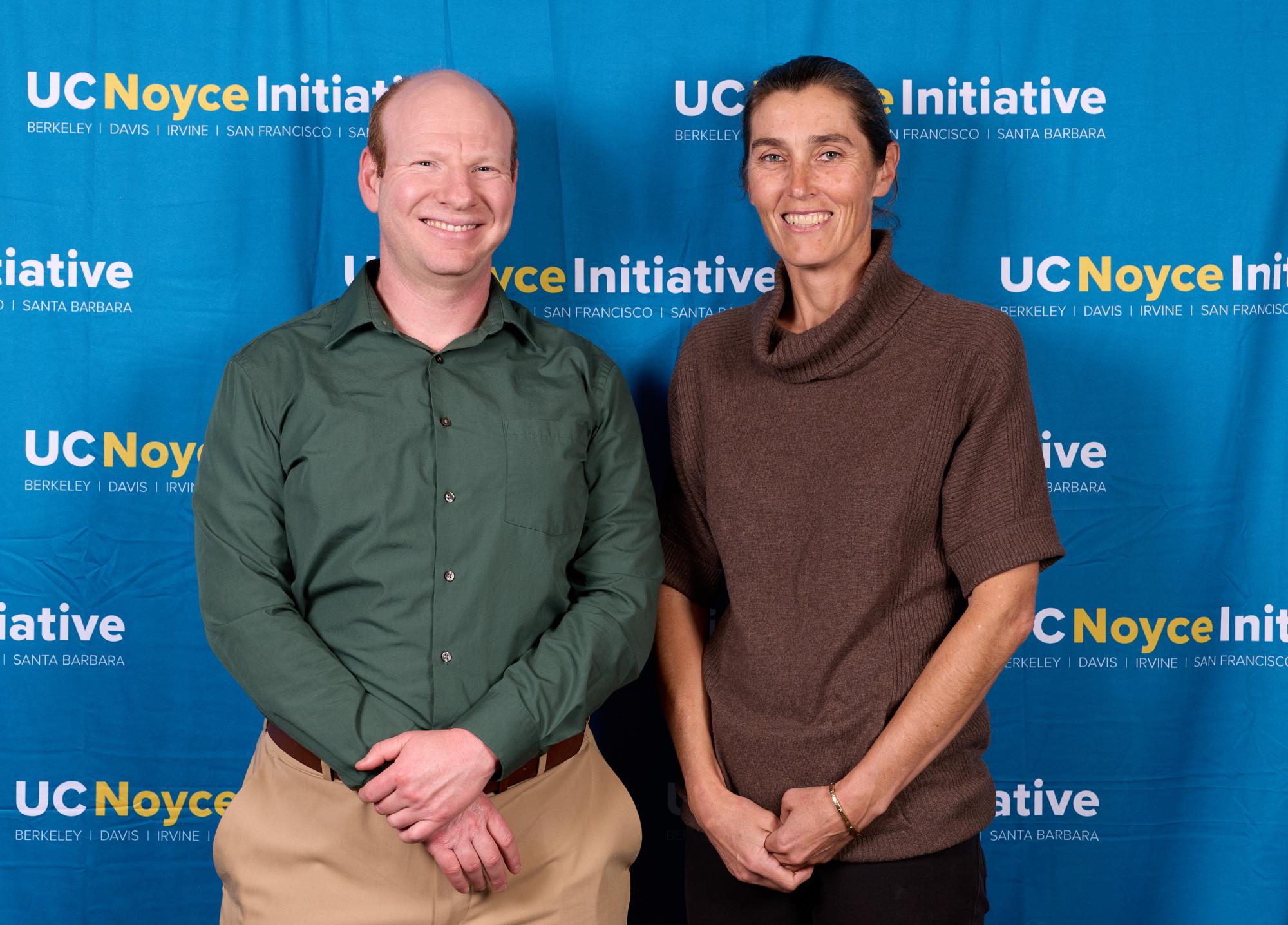
The Research Team
Deep inside a diamond's crystal structure, an occasional carbon atom can be replaced by a nitrogen atom next to an empty space. Known as a nitrogen-vacancy, or NV, center, this tiny imperfection has quantum properties that allow researchers to use it as an extraordinarily sensitive sensor.
A UC Noyce Initiative-supported team spanning UC Berkeley, UC Irvine and UC Santa Barbara is working to unlock the full potential of these diamond quantum sensors. Their goal is ambitious. The researchers want to bring the tiny sensors within just nanometers of a sample. Basically, bring sensors close enough to detect extraordinarily faint signals while still maintaining their stability and sensitivity. Ultimately, they hope to operate many sensors at once, allowing researchers to capture far more information at the nanoscale than would be possible with a single sensor.
Getting closer without losing the signal
Proximity is crucial at this scale. Researchers want to bring diamond quantum sensors extremely close to a target, potentially as small as a single molecule. But moving a sensor close to the diamond’s surface can interfere with its delicate quantum properties and diminish its performance. The team is tackling that fundamental challenge while also developing methods that could make nanoscale sensing more reliable and scalable.
During the project, researchers demonstrated that they could engineer stable NV centers extremely close to the diamond’s surface and position them within nanometers of two-dimensional materials. From that vantage point, the sensors revealed intriguing magnetic behavior that would otherwise be extremely difficult to detect. They mapped tiny areas where magnetism behaved differently from one spot to another – information that could help scientists better understand and ultimately control how these materials behave. Researchers also observed intricate magnetic patterns that could eventually help scientists develop new ways to store and process information in smaller, faster and more energy-efficient devices.
At the same time, the team developed a new technique for preparing and controlling hundreds to thousands of individual NV centers in parallel, improving scientists’ ability to read information from many quantum sensors rather than painstakingly addressing them one at a time.
Together, those advances address two major hurdles: getting quantum sensors extraordinarily close to what scientists want to study and making the technology practical enough to operate at larger scales.
From materials to biology
The work is also creating research directions the team did not necessarily anticipate at the outset.
The highly sensitive diamond sensors sparked discussions with UC Santa Barbara molecular and cellular biologist Max Wilson. The team is engaged in conversations exploring how these advances could accelerate the development of an entirely new class of quantum sensors built around proteins. By creating ways to rapidly test many potential sensor designs, the team hopes to identify the most promising candidates much faster. It is an important step toward bringing quantum sensing to the molecular environments where biology happens.
Other collaborations are emerging as well. Technology developed through the project is being explored alongside molecular-qubit research at UC Berkeley, while UC Noyce funding has also supported an ongoing collaboration between the Kolkowitz group at Berkeley and researchers at Princeton.
The research has already contributed to two published scientific papers, including a 2025 paper in Nature on using quantum entanglement to enhance nanoscale sensing, with another paper currently in preparation.
For a technology built around microscopic imperfections, those defects in diamond are revealing some possibilities that some might consider priceless.