


Let There Be Light
A UC Noyce team is using integrated photonics to tackle one of quantum computing's persistent challenges
For as foreign as quantum computing may be to many, one of its most persistent challenges is rooted in something surprisingly familiar – light.
And a four-campus UC team is showing tremendous promise in finding a solution, thanks to support from the UC Noyce Initiative.
A promising path forward
In quantum computing, scientists use quantum bits, also known as qubits, in place of the 1s and 0s used in conventional computing. Qubits can be created in several ways. One method uses trapped ions, which are electrically charged atoms that scientists manipulate using precisely controlled lasers.
Today, these experiments require elaborate arrangements of lasers, lenses and other optical equipment. As researchers attempt to build larger quantum computers with thousands or tens of thousands of qubits, delivering light precisely to each atom becomes increasingly complex.
The UC Noyce Initiative team is combining their expertise in atomic physics, ion traps, nanophotonics and integrated photonics to find a solution.
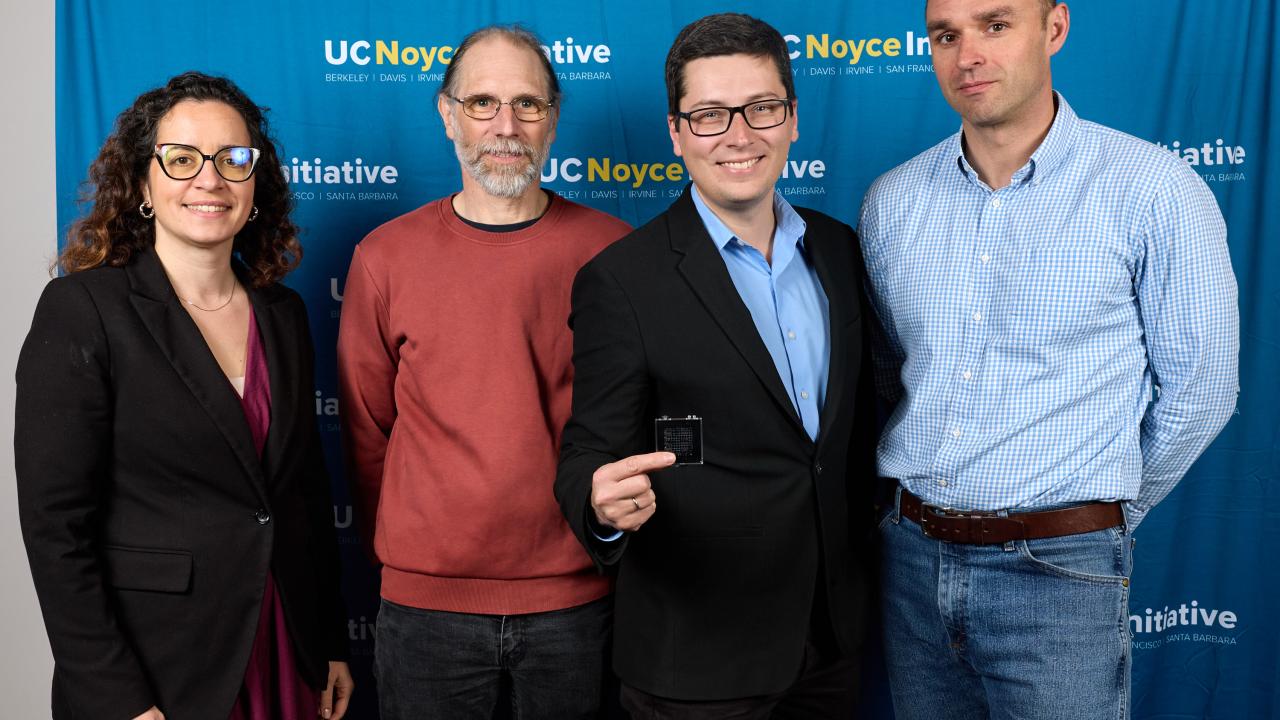
The team is led by Associate Professor Andrew Jayich of UC Santa Barbara and includes Professor Hartmut Häffner of UC Berkeley, Associate Professor Marina Radulaski of UC Davis and Assistant Professor Maxim Shcherbakov of UC Irvine – all of whom are leading researchers in their respective fields.
Together, they are using integrated photonics to take a different approach. Just as electronic circuits use wires to carry electrical signals, photonic circuits use microscopic structures called waveguides to carry and direct light. Incorporating those pathways into an ion trap could allow researchers to deliver light to individual atoms without relying on an increasingly complicated network of traditional optics, which are bulky and often require tuning up (e.g. steering laser beams).
In short, the team is bringing light onto a chip, thereby replacing bulky external optics with a more compact way of guiding light. Their next-generation ion trap stands to address one of the most pressing problems in scaling quantum computers: delivering light to the individual atoms that make up their qubits.The approach could make quantum systems smaller, more stable and, critically, easier to scale.
The Noyce legacy
The approach is reminiscent of another technological revolution – the integrated circuit. Robert Noyce, namesake of the trust that supports the UC Noyce Initiative, co-invented a way to integrate multiple electronic components onto a single silicon chip. The breakthrough helped make increasingly complex electronic systems smaller, more reliable and ultimately easier to manufacture at scale.
The parallel is not lost on the researchers.
“Just as Robert Noyce transformed modern computers with his innovations,” Häffner said when he presented the team’s work at the 2026 UC Noyce Initiative Symposium, “we aspire to do the same for quantum science with our chip.”
Collaboration fuels innovation
The project grew from a problem the researchers already recognized, but UC Noyce helped bring together the expertise and freedom to tackle it in a new way. A workshop held at UC Berkeley encouraged researchers from different campuses and disciplines to think boldly about problems that might require years, rather than months, to solve.
For Shcherbakov, whose UC Irvine lab specializes in integrated photonics, the collaboration offered a natural intersection between fields. His team designs photonic circuits capable of addressing individual trapped ions. Radulaski's UC Davis group brings expertise in nanophotonics and fabrication, while Jayich and Häffner contribute deep expertise in atomic physics and trapped-ion systems.
Together, those complementary areas of expertise made possible a project that would have been difficult for any one laboratory to undertake.
“It’s very important and something that not a single research group could do,” Häffner said.

From ambitious idea to working chip
Making the concept work, however, meant confronting the messy reality of building something at extraordinarily small scales.
The team developed and tested a new multi-step fabrication process, learning along the way that techniques that work independently do not always work when combined. Radulaski recalled one test in which metal delaminated from a chip, a setback that forced the researchers to reconsider designs and processing steps they had initially taken for granted.
“That’s where the learning happened,” Radulaski said.
Those lessons are important because the team's ambition extends beyond making a single successful device. Integrated photonics could eventually allow quantum hardware to take advantage of the kind of specialized fabrication infrastructure that transformed conventional electronics.
Shcherbakov pointed to the accessibility of today's consumer electronics as an example of what manufacturing at scale can accomplish. The long-term vision, he said, is to translate some of the same principles used by microelectronics foundries to quantum technology thereby producing robust photonic chips that can be reliably replicated rather than painstakingly assembled one at a time.
The project has already produced three significant papers during the reporting period, including one in Nature, and generated strong interest from industry.
But beyond the publications, the four faculty on the project say one of the most important outcomes may be the people it is preparing to lead that industry.
Developing the quantum workforce
The group singled out UC Irvine graduate student Melika Momenzadeh for her leadership in the project, including coordinating work across disciplines and institutions.
“The success of that project is largely due to Melika and the students,” Häffner said.
Momenzadeh's work on integrated photonic circuits helped lead to a summer internship at Quantinuum, a major trapped-ion quantum computing company, and subsequently a full-time job offer. Another UC Irvine student interned with photonics company Lumos Infinitas, while a UC Santa Barbara undergraduate received a Worster Fellowship for summer 2026. At UC Davis, Radulaski’s doctoral student Nathan Gonzalez was selected for the inaugural cohort of the UC Noyce Graduate Student Fellowship Program, where he will continue advancing research on scalable photonic platforms for quantum technologies.
For Shcherbakov, developing scientists and engineers who understand both integrated photonics and quantum hardware is an important part of the project's impact. As quantum technologies move from laboratories toward industry, that interdisciplinary expertise will be increasingly important.
Funding bold ideas
The project also demonstrates the role UC Noyce funding can play in getting high-risk, interdisciplinary ideas off the ground.
Unlike funding tied to narrowly prescribed deliverables, the researchers said UC Noyce support gave them freedom to experiment, change direction when necessary and pursue an ambitious idea whose outcome was far from guaranteed.
“These types of funds are so important for science,” Radulaski said, describing the value of having the freedom to try daring approaches.
The team now wants to continue refining its fabrication processes and demonstrating what integrated photonics can make possible for trapped-ion systems. They hope their early success will spur additional research funding from industry, government and philanthropic partners to continue their work.
And its potential extends beyond quantum computing. The same technology could ultimately benefit atomic-physics experiments more broadly, where researchers face similar challenges manipulating atoms with extraordinary precision.
“Such solutions promise to revolutionize not just quantum computing,” Jayich said, “but the entire field of atomic physics, by allowing researchers to create more reliable and significantly smaller optical components.”